
On this page
The teaching examples on this page are original and not officially scored. Written responses illustrate content and structure; an official Speaking level also depends on the recorded delivery and the full performance.
A CELPIP Speaking practice test with answers can help, and it can also quietly make you worse.
If you read sample answers like scripts, you start chasing polished sentences instead of building the skill the test scores: answering the task clearly, under a timer, in a way a rater can follow.
So read the pairs below for what changes when a response moves from thin to stronger, rather than for lines to memorize.
Key takeaways
- CELPIP Speaking has 8 recorded tasks, and each task rewards a different kind of response control.
- A useful sample answer should show the scoring gap, not just the “perfect” version.
- Stronger answers usually improve four things: Content/Coherence, Vocabulary, Listenability, and Task Fulfillment.
- Well-developed responses are not necessarily fancy. They are specific, organized, complete, and easy to listen to.
- After reading each answer, record your own version and compare it against one scoring dimension at a time.
How to use this CELPIP Speaking practice test
Use this article like a mini diagnostic, not a reading exercise.
For each task:
- Read the prompt.
- Set the real prep timer.
- Record your answer before looking at the sample.
- Compare your response with the answer below.
- Pick one scoring dimension to improve.
- Record the same prompt again.
If you want the full exam flow first, start with a CELPIP Speaking practice test. If one task is clearly weaker, drill it afterward in single-task speaking practice.
The official CELPIP Speaking test is recorded on a computer and includes eight speaking tasks (CELPIP test format). CELPIP also explains that trained raters evaluate speaking responses and report results as CELPIP levels, which map to Canadian Language Benchmark levels for immigration purposes (CELPIP test results, Canada.ca language test equivalency).
So the question is not:
Did this answer sound impressive?
It is:
Would this answer give a rater enough evidence across the rubric?
The scoring lens: what better answers actually do
Possible issues to review include general or poorly organized ideas, vocabulary gaps, grammar, delivery that is hard to follow, or an answer that only partly matches the task. Check the recording rather than assuming which one caused the difficulty.
Use this four-part review:
| Dimension | What to check | Common weak pattern |
|---|---|---|
| Content/Coherence | Are ideas organized and developed? | Random points with no clear path |
| Vocabulary | Are words specific and natural? | Generic language like “good,” “important,” “many things” |
| Listenability | Is it easy to understand out loud? | Fast pace, long sentences, unclear transitions |
| Task Fulfillment | Did you do exactly what the prompt asked? | Answering the topic but missing the role, tone, or purpose |
For CLB 9, the answer needs to feel controlled without tipping into robotic, which mostly means sounding like you know where it is going.
Task 1: Giving advice
Prep time: 30 seconds
Speaking time: 90 seconds
Prompt: Your friend has been accepted into their first-choice college, but they are worried about paying tuition. Give your friend advice.
Weak answer
Congratulations on getting accepted. I think you should not worry too much because many students have this problem. You can get a job, ask your parents, or maybe apply for some scholarship. Education is very important, so you should try your best and not give up. If you work hard, everything will be fine.
This answer is understandable, but it is thin. The advice is generic, and the speaker does not sound like a real friend solving a real problem.
Stronger answer
First of all, congratulations. That is a big achievement, and I do not think you should give up on the school just because the tuition looks scary right now. I would do three things this week. First, call the financial aid office and ask about entrance scholarships, payment plans, and emergency grants. Second, apply for a part-time campus job, because campus work is usually easier to balance with classes. Third, make a simple budget for rent, transportation, books, and food so you know the real gap. Once you know the exact amount, the problem will feel less emotional and more practical. If you want, I can help you review the scholarship applications this weekend.
What the revision improves
- Content/Coherence: The advice has a sequence: call financial aid, find work, make a budget.
- Vocabulary: “Financial aid office,” “payment plans,” “campus job,” and “real gap” are specific to the situation.
- Listenability: The answer uses short sections that are easy to follow.
- Task Fulfillment: It sounds like advice to a friend, not an essay about education.
Task 2: Talking about a personal experience
Prep time: 30 seconds
Speaking time: 60 seconds
Prompt: Talk about a time when you had to learn something difficult. Explain what happened and what you learned.
Weak answer
One time I learned driving. It was very difficult because I was nervous and there were many rules. My teacher helped me and I practiced many times. Finally, I passed my test. I learned that practice is important and people should not give up when something is difficult.
The answer has a story, but it is broad enough that it could belong to anyone.
Stronger answer
A few years ago, I had to learn how to drive in winter, and honestly, it was much harder than I expected. I already knew how to drive in normal weather, but the first time my car slipped a little on an icy side street, I panicked and braked too hard. After that, I booked two lessons with an instructor who specialized in winter driving. He taught me to slow down before turns, leave more distance, and avoid sudden movements. The biggest lesson was that confidence does not come from pretending you are not scared. It comes from practicing the exact situation that scares you until your reaction becomes calmer.
What the revision improves
The stronger answer gives a clear moment, a problem, an action, and a lesson. That is what many Task 2 answers are missing. You do not need a dramatic life event. You need a specific experience with enough detail for the listener to follow.
Task 3: Describing a scene
The comparison below is a text-only planning exercise using an imagined park. Use the real picture practice that follows to practise describing visible details.
Prep time: 30 seconds
Speaking time: 60 seconds
Prompt: Describe a busy public park scene. Include the people, objects, and activities you notice.
Weak answer
In this picture, I can see many people in a park. Some people are walking and some people are sitting. There are trees and benches. Maybe it is a nice day. There is a family and children are playing. Everyone looks happy and the park is beautiful.
This answer lists obvious details. Listing is not the same as describing.
Stronger answer
The scene shows a busy park on what looks like a sunny weekend afternoon. In the foreground, a family is sitting on a blanket near a picnic basket, and two children are playing with a ball just a few steps away. On the left side, an older man is walking a small dog along the path, while several people sit on benches under the trees. In the background, there seems to be a playground and a group of cyclists passing by. Overall, the park feels lively but relaxed, with different people using the same space for exercise, family time, and a break from the city.
What the revision improves
The answer organizes the scene by location: foreground, left side, background, overall impression. That structure helps listenability. It also uses more precise vocabulary: “picnic basket,” “path,” “benches,” “playground,” “cyclists,” “lively but relaxed.”
For Task 3, do not try to describe every pixel. Pick a route through the image.
Practise with a visible picture
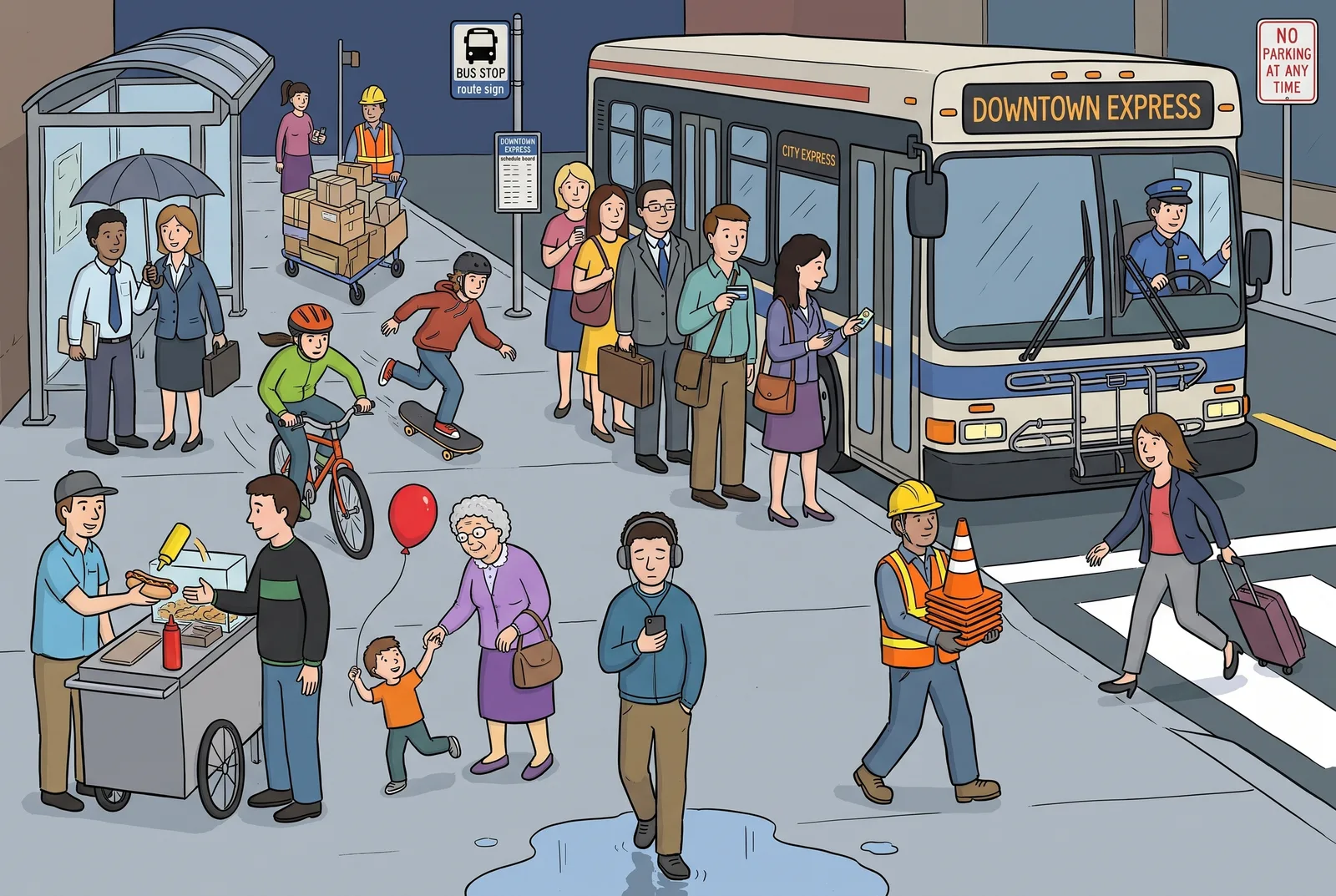
Describe what is happening at this bus stop to someone who cannot see the picture. Prepare for 30 seconds, then speak for 60 seconds.
Read an illustrative answer and review notes
This is a busy city bus stop with several activities happening around the queue. On the right, passengers are waiting beside a large bus, and the woman at the front is holding money. In the lower left, a food vendor is handing a hot dog to a customer. Nearby, a small child holding a red balloon is reaching toward an older woman. In the centre, a man wearing headphones is looking at his phone while walking through a puddle. A worker carrying traffic cones is crossing the foreground. Overall, the pavement looks crowded, with commuters, workers and children sharing the space.
Check the order: bus queue, food stall, child, then the foreground. The answer describes visible details. It does not claim to know the people's relationships, jobs or intentions beyond what the picture supports.
This is an unscored teaching example, not an official CELPIP response or level prediction.
Task 4: Making predictions
The comparison below is a text-only planning exercise using an imagined rainy bus stop. For picture-based practice, use the illustration that follows, which is the same scene shown in Task 3.
Prep time: 30 seconds
Speaking time: 60 seconds
Prompt: Look at a scene where people are waiting at a bus stop under dark clouds. Predict what might happen next.
Weak answer
I think it will rain. The people will maybe take the bus. Some people will go home and some people will use umbrellas. Maybe the bus will come late, and people will be angry. That is all.
The predictions are possible, but they are undeveloped.
Stronger answer
I think it is probably going to start raining in the next few minutes because the sky is very dark and the people at the bus stop already look uncomfortable. One man may open his umbrella, and the woman beside him might move closer to the shelter so her bag does not get wet. If the bus is delayed, the crowd could become frustrated, especially because everyone seems dressed for work or school. I also think one person might check a transit app or call someone to say they are running late. So the scene will probably change from calm waiting to a more stressful situation once the rain begins.
What the revision improves
The speaker does not just say what might happen. They explain why. Task 4 rewards supported predictions, not random guesses.
Use this pattern:
Prediction → visual clue → likely consequence
That simple structure makes the answer sound more mature.
Practise with a visible picture
Use the same bus-stop picture as Task 3. Predict what might happen next and explain the visible clues. Prepare for 30 seconds, then speak for 60 seconds.
Read an illustrative answer and review notes
The passengers will probably start boarding soon because they are lined up beside the bus and the woman at the front has her fare ready. The man with headphones may look down when he notices his shoes getting wet; he is focused on his phone while walking through a puddle. Meanwhile, the worker carrying cones will likely set them down somewhere nearby, perhaps to mark an area people should avoid. If the cyclist and skateboarder continue through the crowded pavement, they may have to slow down to make room for pedestrians. Overall, people will need to watch where they are going as the queue begins to move.
Each prediction has a visible basis. 'Perhaps' marks the cone placement as uncertain. Other outcomes are possible; explain a plausible next event rather than inventing a backstory.
This is an unscored teaching example, not an official CELPIP response or level prediction.
Task 5: Comparing and persuading
Prep time: 60 seconds for silent selection, then 60 seconds to prepare
Speaking time: 60 seconds
Simplified comparison drill: In the full Task 5 flow, you first silently select between two options. A new alternative then appears for the preparation and persuasion stage. This pair practises comparison and persuasion; see the complete Task 5 exercise for the full sequence.
Prompt: Your community centre can add either a fitness room or a quiet study room. Choose one option and persuade the committee.
Weak answer
I think the fitness room is better because people need exercise. Health is very important, and many people do not have time to go to the gym. A fitness room can help everyone become healthy. The study room is also good, but the fitness room is better because it is useful.
This is an opinion, but not much persuasion.
Stronger answer
I would strongly recommend adding the quiet study room. A fitness room sounds attractive, but it would probably be expensive to maintain because the centre would need equipment, cleaning, safety rules, and maybe extra insurance. A study room is simpler and would serve a wider group: students preparing for exams, newcomers taking language classes, parents who need a quiet hour to complete paperwork, and remote workers who cannot focus at home. It also fits the purpose of a community centre because it gives people a calm, shared space without creating high operating costs. For those reasons, I think the study room is the more practical choice.
What the revision improves
Task 5 asks you to compare and persuade, not just choose. The stronger answer acknowledges the other option, explains the tradeoff, and gives audience-relevant reasons.
If your Task 5 answers feel weak, add contrast:
Option A is attractive, but Option B is more practical because...
Use that contrast to introduce a relevant persuasive reason, then check whether the whole answer supports your choice.
Task 6: Dealing with a difficult situation
Prep time: 60 seconds
Speaking time: 60 seconds
Tone and explanation drill: Complete Task 6 practice involves choosing a decision and explaining it to the selected person. The refund scenario below isolates a useful tone exercise; see the complete Task 6 example for a choice-based prompt.
Prompt: You work at a small electronics store. A customer wants a refund for headphones they bought three months ago, but the store policy allows returns only within 30 days. Explain the situation and offer a solution.
Weak answer
I am sorry, but we cannot give you a refund because our policy is 30 days. You bought it three months ago, so it is impossible. Maybe you can call the company or buy another one. I understand your problem, but I cannot help you.
The answer is clear, but the tone is too blunt. Task 6 often tests tact.
Stronger answer
I understand why you are frustrated, especially if the headphones stopped working sooner than you expected. Unfortunately, our store refund policy only covers the first 30 days, and this purchase was made about three months ago, so I am not able to process a cash refund today. What I can do is check whether the headphones are still covered by the manufacturer warranty. If they are, I can help you submit a warranty claim or contact the company from the store so you do not have to figure it out alone. I know that is not the exact answer you wanted, but it is the best way for us to solve the problem within the policy.
What the revision improves
The stronger answer does three things at once:
- Shows empathy.
- Explains the rule clearly.
- Offers a next step.
In this tone drill, the response explains the decision respectfully and offers a relevant next step. A next step is useful when appropriate; it is not required to satisfy both parties in every Task 6 decision.
Task 7: Expressing an opinion
Prep time: 30 seconds
Speaking time: 90 seconds
Prompt: Do you think high school students should be required to learn a second language? Explain your reasons.
Weak answer
Yes, I think students should learn a second language because it is very important. They can get better jobs and communicate with more people. Also, learning a language is good for the brain. Some students may not like it, but school is for learning important things, so I think it should be required.
This answer is fine at the idea level. It just does not develop enough.
Stronger answer
Yes, I think high school students should be required to learn a second language, but the course should focus on practical communication instead of memorizing grammar for tests. A second language can help students understand different cultures, and in a country like Canada it can also create real career advantages, especially for government, customer service, and healthcare jobs. Even if students do not become fluent, learning another language teaches them how difficult communication can be for newcomers, which makes them more patient and open-minded. I understand that not every student will enjoy it, but the purpose of school is partly to expose students to skills they may not choose on their own. For that reason, I think it should stay required, as long as the teaching is useful and realistic.
What the revision improves
The stronger answer has a clear position, gives multiple reasons, handles the opposing view, and ends with a qualified conclusion. That is much stronger than repeating “it is important.”
For Task 7, avoid one-sided slogans. A small concession often makes the answer sound more natural.
Task 8: Describing an unusual situation
The comparison below is a text-only planning exercise using an imagined delivery robot. Use the picture practice that follows to describe an unusual situation someone else cannot see.
Prep time: 30 seconds
Speaking time: 60 seconds
Prompt: You see a delivery robot stuck in the middle of a grocery store aisle, blocking several shoppers. Call your friend and describe what is happening.
Weak answer
Hi, I am in the store and something strange is happening. There is a robot and people are looking at it. It is blocking the way. Some people are laughing and some people are angry. I think someone will fix it soon.
This answer identifies the situation, but it does not make the unusual detail vivid.
Stronger answer
Hey, you will not believe what I am looking at right now. I am in the grocery store, and one of those small delivery robots is completely stuck in the middle of the aisle, right between the cereal shelves and the freezer section. It keeps turning slightly left and right like it is trying to escape, but it is not moving forward. A few shoppers are laughing and recording it, but an older woman with a cart looks annoyed because she cannot get past. One employee is on the phone, probably calling a manager or the company that owns the robot. It is not dangerous, but it is definitely creating a weird little traffic jam inside the store.
What the revision improves
Task 8 is about making the listener understand a strange situation they cannot see. The stronger answer gives location, movement, people’s reactions, and the level of seriousness.
Think like this:
What is strange? Where is it? Who is affected? How urgent is it?
Practise with a visible picture
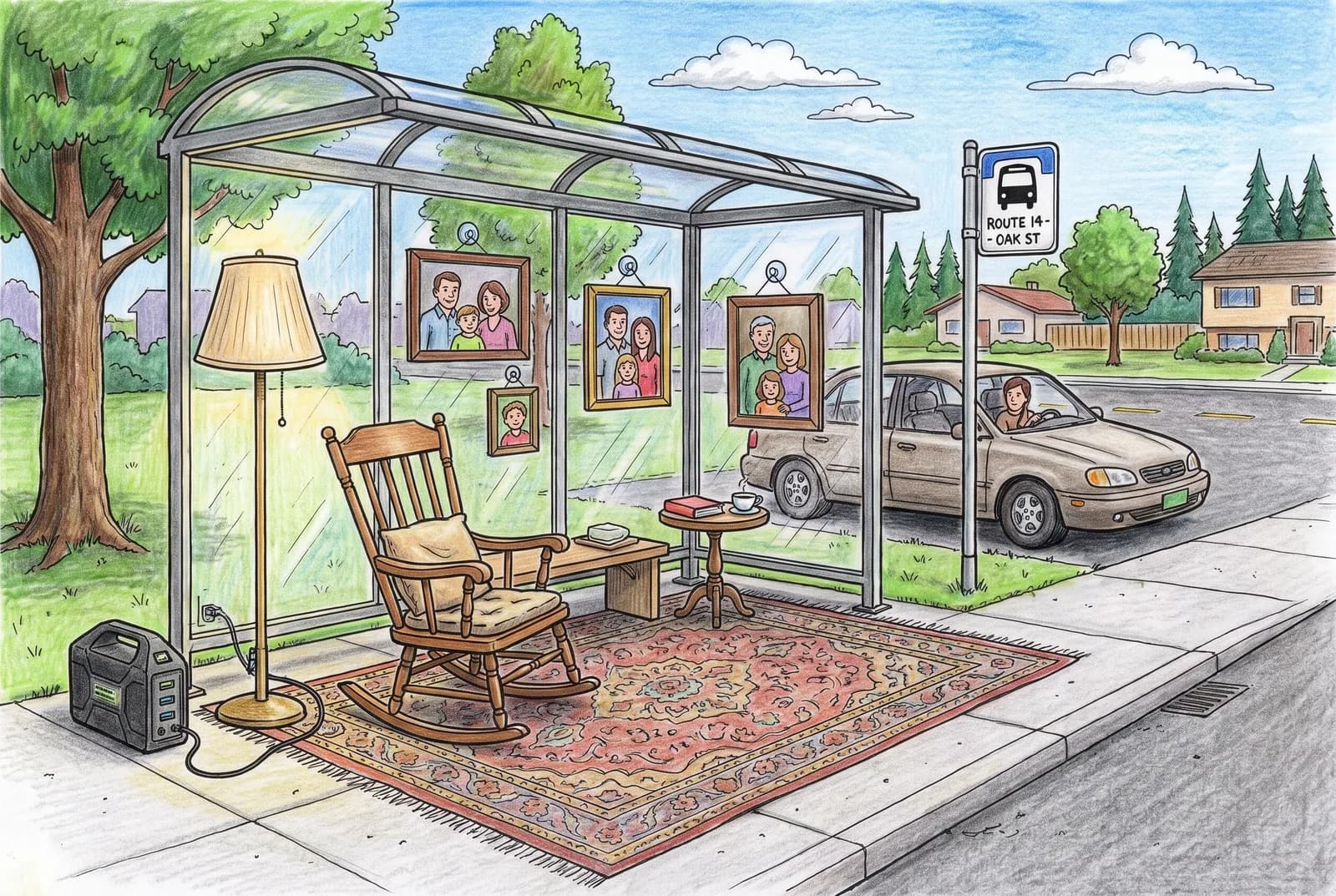
You are waiting at this unusual bus shelter. Call the transit information line, describe what you see, and ask whether it is an approved display or needs a safety check. Prepare for 30 seconds, then speak for 60 seconds.
Read an illustrative answer and review notes
Hello, I'm calling about the Route 14 shelter on Oak Street. It looks as though someone has turned it into a small living room. There is a wooden rocking chair on a patterned rug, with a tall floor lamp beside it. Several framed family photographs are hanging on the glass walls, and a little round table holds a cup and a book. What concerns me is the cable running from a portable power unit toward the lamp near the edge of the rug. Could you check whether this is an approved art display? If it is, it might need a sign and a check that the cable is safe for passengers walking through.
The caller names the location, describes the unusual objects, and makes a specific request. The safety concern is framed as something to check, not as a confirmed hazard.
This is an unscored teaching example, not an official CELPIP response or level prediction.
A simple answer template for all 8 tasks
Memorize response shapes rather than full sample answers.
| Task | Response shape |
|---|---|
| Task 1 | Warm opening → 2-3 specific pieces of advice → supportive closing |
| Task 2 | Situation → problem → action → lesson |
| Task 3 | Overall scene → organized details by location → summary impression |
| Task 4 | Prediction → visual clue → consequence |
| Task 5 | Choice → contrast → 2-3 persuasive reasons → recommendation |
| Task 6 | Decision → reasons → respectful explanation/next step |
| Task 7 | Position → reasons → example/concession → conclusion |
| Task 8 | Strange detail → location → reactions → seriousness/next step |
These shapes are a starting structure to practise and adapt to each prompt.
How to review your own answers
After you record a response, “was it good?” is too vague to act on. Use this checklist instead:
1. Did I answer the exact task?
If the prompt asks for advice, give advice. If it asks you to persuade, persuade. If it asks you to describe, describe.
A fluent answer still loses marks when it does the wrong job.
2. Did I give enough specific detail?
Replace vague phrases with concrete ones.
Weak:
You should practice more and be confident.
Better:
You should record one 90-second answer every night, then replay it once and write down one mistake to fix tomorrow.
Specific language sounds more advanced because it gives the listener something to picture.
3. Did my answer have a clear path?
The listener should feel your structure even without seeing your notes.
Use simple transitions:
- First
- The main reason
- For example
- On the other hand
- That is why
Do not overuse them. Just enough to make the path obvious.
4. Was I easy to listen to?
Listenability is about clarity rather than a perfect accent.
Check:
- Did I speak too fast?
- Did I pause in natural places?
- Did I restart sentences too often?
- Did I finish with a clean ending?
If you keep running out of time, check whether the cause was too much content, language retrieval, pauses or misunderstanding the task.
The right next step
Sample answers earn their keep only when they change how you practise.
Pick one task from this article and record your answer twice:
- First attempt: real timer, no help.
- Second attempt: same prompt, but improve one dimension only.
Do not try to fix everything in one recording, which is how people burn out.
Take Speaking Exam 1, a free full mock, and review your recordings with the checklist above. A free account includes one welcome AI feedback credit; feedback for every answer is separate from free mock access. If you already know your weakest task, go directly to task-specific speaking practice and train that one skill until the structure feels automatic.
Used that way, a sample answer works as a mirror rather than a script.
Put it into practice
Try a free full Speaking mock
Exam 1 is free in Speaking, Writing, Listening and Reading. Practice with the timers, then review your work. A free account includes one welcome AI feedback credit for Speaking or Writing; test access is separate.