
Free CELPIP practice workbook and PDF
Download a free 26-page CELPIP practice workbook for speaking, writing, reading and listening. Work through original questions, sample answers and a four-week study plan. Print it or use the fillable PDF, with no sign-up.
Printable & fillable PDF. No account. No email. Just open and start.

Cover 1 / 6
A look inside the actual workbook. Click a page to open it.

Understand the answer.
Original Reading and Listening drills with evidence for the right answer and explanations for the traps.

See what stronger looks like.
Complete Writing examples, Speaking responses and small revisions that make a real difference.

Know what to do next.
A four-week routine, fillable practice log and response review sheet to use alone or with your teacher.
Open the companion
Good practice starts here.
Explore every chapter below, or keep the whole workbook beside you as a PDF. Try the exercises before opening the answer pages.

Chapter 01 / Pages 2-4
Start here
Chapter 01 / Pages 2-4
Start here
02Make this pack yours.
Start with one useful session, not a perfect study schedule.
This companion is for CELPIP-General learners who want a practical way to prepare across all four skills. Use it alongside official sample tests and, when you need individual guidance, a teacher.
01 / Try
Attempt the exercise before reading the example or answer key. Keep your first answer so you can see what changes.
02 / Explain
Find the exact detail, sentence or moment that made your answer work or fail.
03 / Repeat
Make one specific change. Try again, then use a fresh question to see whether the improvement transfers.
| Inside | Pages |
|---|---|
| Format & self-review | 03-04 |
| Listening: notes, mini drill & transcript | 05-07 |
| Reading: all four parts & answer explanations | 08-11 |
| Writing: plans, models & revision | 12-15 |
| Speaking: all eight tasks & visual practice | 16-22 |
| Study plan, worksheets & useful sources | 23-26 |
My test date / target for each skill
Space to complete in your downloaded workbook.
The one thing I most want to improve
Space to complete in your downloaded workbook.
A workbook, not a score prediction
The short exercises teach individual skills. They are not full test sections, and their results cannot be converted into a CELPIP level. Model answers are original teaching examples, not examiner-rated responses.
03Know the test.
Understand the shape of the exam before you practise the details.
| Component | What to expect | Time |
|---|---|---|
| Listening | 6 scored parts / 38 scored questions | 46-55 min |
| Reading | 4 scored parts / 38 scored questions | 43-56 min |
| Writing | An email + a survey response | 53 min |
| Speaking | 8 tasks / recorded responses | 15 min |
CELPIP-General is computer-delivered in one sitting. The LS version covers Listening and Speaking only. This workbook covers General. Follow the instructions and timer on your test screen.
Why Listening and Reading have time ranges
Unscored material may appear in these components. You cannot identify it, so give every item your best effort. The scored question totals above do not describe every item you may see.
Prepare for the interface
Use an official online sample test to learn the screens, audio flow and timing. A paper exercise cannot reproduce the full computer experience.
Separate skill from speed
First learn how to solve a question. Then repeat with a timer. If you always rush, you may rehearse the same misunderstanding.
Keep the four scores separate
Track Listening, Reading, Writing and Speaking individually. A strong result in one skill does not explain what needs work in another.
My baseline: L / R / W / S, resource used and date
Space to complete in your downloaded workbook.
Format checked against the official CELPIP Test Format & Scoring page and July 2026 Guidebook on 9 September 2026. Official sources are linked on page 26.
References: Official CELPIP Test Format & Scoring · CELPIP Guidebook for Test Takers / July 2026
04Know what to improve.
A good review points to evidence, not just a number.
Speaking and Writing are assessed across four dimensions. Use the questions below to inspect your own work. The third dimension differs: Listenability for Speaking, Readability for Writing.
| Dimension | Find evidence in your response |
|---|---|
| Content / Coherence | Where did I explain my main idea? Which detail makes it convincing? |
| Vocabulary | Which words describe this exact situation? Did a word choice change my meaning? |
| Listenability / Readability | Speaking: are pronunciation, grammar and phrasing clear? Writing: do grammar, paragraphs, spelling and punctuation make the message easy to follow? |
| Task Fulfillment | Did I address the right person, cover every instruction and use a suitable tone and length? |
A useful review sounds like this
My recommendation is clear, but I only say the apartment is convenient. On my next attempt I will explain that it is a ten-minute walk from work, so my friend can avoid the bus fare.
Listening & Reading
Record the answer, the evidence and why your chosen distractor fails. A lucky guess belongs in your review log too.
Speaking & Writing
Save a short excerpt that needs work. Rewrite it, say it aloud, or ask a teacher to explain what the reader or listener is missing.
Use official examples to understand levels
The official Score Comparison Chart includes rated samples and commentary. Compare how an answer develops ideas and handles language; do not turn this checklist into an unofficial scoring formula.
My next improvement, with one piece of evidence
Space to complete in your downloaded workbook.
References: Official CELPIP Score Comparison Chart · Writing Pro: Target 9+ / official study pack · Speaking Pro: Target 9+ / official study pack

Chapter 02 / Pages 5-7
Listening
Chapter 02 / Pages 5-7
Listening
05Listen for the change.
Keep track of who wants what, and what is finally decided.
| Part | Questions | A useful note-taking focus |
|---|---|---|
| 1 / Problem Solving | 8 | Problem, possible solutions, final decision |
| 2 / Daily Life Conversation | 5 | Relationship, purpose, feelings |
| 3 / Information | 6 | Main topic, categories, specific details |
| 4 / News Item | 5 | Event, cause, effect, next step |
| 5 / Discussion | 8 | Who holds each view, and why |
| 6 / Viewpoints | 6 | Main position, support, qualification |
These are practice prompts for your notes, not rules about what every question asks. Listen for meaning. If you write full sentences, you may miss the next idea.
What a change can sound like
We could meet on Tuesday. Actually, the room is being repaired then. Thursday is better, provided we finish before six.
| Rough notes | What they preserve |
|---|---|
| Tue X / repair | The first proposal was rejected. |
| Thu / finish < 6 | The new day includes a condition. |
- When a speaker changes direction, update your notes instead of keeping two competing answers.
- For an attitude question, combine wording and tone with the situation. One positive adjective does not settle the whole meaning.
- If you miss a detail, return your attention to the current sentence. Leave a question mark rather than guessing a story.
My note abbreviations: because / changes to / however / example
Space to complete in your downloaded workbook.
References: CELPIP Guidebook for Test Takers / July 2026
06Try it: a change of plan.
A partner-read mini drill / 3 questions / answers on page 07.
Set it up
Ask a partner or teacher to read the transcript on page 07 once at a natural pace while you keep that page hidden. Take brief notes, then answer. Studying alone? Record the script first and return later, or use the official listening resources on page 26. This is a skills drill, not a simulated test part.
Notes: original plan / problem / final arrangement
Space to complete in your downloaded workbook.
1. What will happen on Saturday?
- A. The entire repair workshop is cancelled.
- B. Maya will lead the morning session alone.
- C. The repair workshop will start at 2 p.m.
- D. The workshop will move to next weekend.
2. Why does Leo need Maya to contact the volunteers?
- A. To ask them to bring their own tools.
- B. To tell them about the new start time.
- C. To find a different workshop location.
- D. To reduce the number of people attending.
3. How does Maya respond to the revised plan?
- A. She accepts it and suggests a practical addition.
- B. She agrees only if Leo cancels the morning booking.
- C. She doubts the volunteers will come.
- D. She prefers to postpone the event.
Which answer am I least certain about, and why?
Space to complete in your downloaded workbook.
07Check the evidence.
Read only after you finish the drill on page 06.
Transcript / for the reader
Leo: Hi Maya. About Saturday's bicycle repair workshop: we booked the hall for ten, but the caretaker just called. There's a plumbing inspection until noon. Maya: Could we use the courtyard instead? Leo: I thought of that, but rain is forecast. The hall is free from two, and the mechanic can stay until five. Maya: That should work. Three hours is plenty for the repairs we planned. We could put a sign at the entrance so anyone who misses the update knows when to come back. Leo: Good idea. I'll update the booking. Could you message the volunteers about the later start? Maya: Of course. Should I tell them to bring tools? Leo: No, the mechanic is supplying everything. We just need them there fifteen minutes early to set up.
| Answer | Evidence and why the alternatives fail |
|---|---|
| 1 / C | The hall is free from two, and Leo will update the booking. The event is still on Saturday; no morning session or cancellation is agreed. |
| 2 / B | Leo asks Maya to message volunteers about the later start. Tools are supplied; a different location and reduced attendance are not agreed. |
| 3 / A | Maya accepts the timing and suggests an entrance sign. Her question about tools is practical, not an objection to the plan. |
Notice the distractors
The morning booking was the original plan. A move to next weekend and Maya leading a session alone are never agreed. Check the final arrangement, not the first time mentioned.
One detail I missed / a shorter note that would capture it
Space to complete in your downloaded workbook.

Chapter 03 / Pages 8-11
Reading
Chapter 03 / Pages 8-11
Reading
08Find it. Check it. Choose.
Understand the question, locate the evidence, then compare the options.
| Part | Questions | What to practise |
|---|---|---|
| 1 / Correspondence | 11 | Purpose, relationships, details and implied meaning in messages |
| 2 / Apply a Diagram | 8 | Combining a visual source with a written message |
| 3 / Information | 9 | Matching statements to the paragraph that supports them |
| 4 / Viewpoints | 10 | Separating the writer's position from other people's views |
01 / Set a search target
Identify the person, event or claim in the question. Decide whether you need a fact, a reason, a purpose or an inference.
02 / Read around the match
A matching word is a starting point. Read the surrounding sentence to check negatives, conditions and who is speaking.
03 / Compare the whole claim
The correct option must fit the relevant evidence. Check quantity, timing, certainty and cause, not just the topic.
Make room for inference
Some answers are implied rather than copied from a sentence. A sound inference follows from the text; it does not depend on a personal assumption or outside knowledge.
A small word changes the answer
All members can borrow tools. Only members who complete the safety session can borrow power tools. Membership alone is not enough to borrow a power drill.
My usual reading trap: detail / inference / vocabulary / time
Space to complete in your downloaded workbook.
References: CELPIP Guidebook for Test Takers / July 2026
09Try it: messages & a schedule.
Original mini drills for Parts 1 and 2 / suggested practice time: 6 minutes.
A / Message from the library
Hi Sam, thanks for offering to help at our book sale on Sunday. We already have enough people at the payment desk, but someone is needed to sort donated books before we open at eleven. Could you arrive at nine-thirty? You can leave at noon if you need to. Please use the side entrance; the main doors will still be locked. - Elena
1. Why is Elena writing?
- A. To change the day of the sale.
- B. To ask Sam to sort donated books.
- C. To ask Sam to donate books.
- D. To explain a problem with payments.
2. What should Sam do?
- A. Arrive at eleven and collect payments.
- B. Stay until the library closes.
- C. Enter through the side door at nine-thirty.
- D. Unlock the main entrance at noon.
| B / Community centre class | Time | Cost | Requirement |
|---|---|---|---|
| Basic bike care | 10:00-11:00 | $10 | None |
| Brake adjustment | 11:30-12:30 | $15 | Bring a bicycle |
| Roadside repairs | 14:00-15:00 | $10 | None |
Nora writes: "I work until noon and can reach the centre by 1:30. I can spend at most $12. My bike is at the repair shop, but I still want to learn something useful."
3. Which class meets all Nora's conditions?
- A. Basic bike care.
- B. Brake adjustment.
- C. Roadside repairs.
- D. None of these classes.
4. Why is Brake adjustment unsuitable?
- A. It is free only for members.
- B. It is already fully booked.
- C. It takes place outdoors.
- D. Its time, price and equipment requirement conflict with her situation.
Answers and explanations: page 11. The time above is a workbook practice suggestion, not official part timing.
10Try it: match the meaning.
Original mini drills for Parts 3 and 4 / suggested practice time: 6 minutes.
A / The neighbourhood tool library
Paragraph A: The tool library opened in 2023 after residents donated equipment they rarely used. Members now borrow items instead of buying tools for a single project. Paragraph B: Standard loans last seven days. Borrowers may request one extra week unless another member has reserved the item. Late returns attract a daily fee. Paragraph C: Volunteers inspect every returned item. Damaged tools are removed from circulation until repaired, and new members must attend a safety introduction.
5. Which paragraph explains when a loan can be extended?
- A. Paragraph A.
- B. Paragraph B.
- C. Paragraph C.
- D. Not given.
6. Which paragraph states the annual membership price?
- A. Paragraph A.
- B. Paragraph B.
- C. Paragraph C.
- D. Not given.
B / A viewpoint on evening library hours
The city plans to keep the central library open until nine on weekdays. Some residents argue that low evening attendance would make the extra staffing cost wasteful. Librarian Dana Cho supports a three-month trial: "People who work late cannot use a service that closes before they arrive. We should measure demand after they have a realistic chance to visit." Cho adds that a trial would let the city adjust staffing before committing to permanent hours.
7. Which statement best describes Cho's position?
- A. Evening demand has already been proven high.
- B. A trial would test demand before a long-term commitment.
- C. The city should remove all limits on opening hours.
- D. Staffing costs are irrelevant.
Underline the evidence for questions 5 and 7. For question 6, check all paragraphs before choosing "Not given."
11Why that answer works.
A correct letter is the start of the review, not the end.
| Answer | Evidence | The trap |
|---|---|---|
| 1 / B | The payment desk is covered; Elena asks Sam to sort books. | The event day is unchanged. Books are being sorted, not requested as a donation. |
| 2 / C | The message gives both nine-thirty and the side entrance. | Eleven is the opening time, not Sam's arrival time. |
| 3 / C | 14:00 is late enough; $10 is within budget; no bicycle is required. | A class must meet every condition, not just be affordable. |
| 4 / D | 11:30 is too early, $15 is too much, and Nora has no bike available. | The schedule says nothing about capacity, location outdoors or a membership discount. |
| 5 / B | A further week is possible unless someone has reserved the item. | The extension is conditional, not automatic. |
| 6 / D | None of the three paragraphs states a membership price. | A daily late fee does not tell you the annual membership cost. |
| 7 / B | Cho wants to measure demand in a three-month trial before making hours permanent. | Her support is conditional. She does not claim demand is already proven or costs do not matter. |
When your answer is wrong
Name the mismatch: wrong person, wrong time, too strong, partly true, contradicted or not supported.
When your answer is right
Explain it without pointing at the answer key. If you cannot, mark it as uncertain and revisit it.
One answer I changed after reading the explanation / why
Space to complete in your downloaded workbook.

Chapter 04 / Pages 12-15
Writing
Chapter 04 / Pages 12-15
Writing
12Plan the message first.
Two tasks. Two purposes. A few minutes of planning can save a rewrite.
| Task | Your job | Practice timing |
|---|---|---|
| 1 / Email | Write to a particular person and address every instruction. | 27 minutes |
| 2 / Survey | Choose an option and explain why it is preferable in the given situation. | 26 minutes |
Aim for 150-200 words per task and follow the screen instructions. Word count is part of Task Fulfillment. Official guidance allows a little flexibility, but being significantly over or under the suggested range can lower your score.
Before writing / about 4 minutes
Note the reader, purpose, required points and one concrete detail for each main idea.
Draft / the middle of your time
Give each paragraph a job. Develop the idea instead of filling space with a memorized opening.
Review / about 3 minutes
Check the task instructions first, then unclear sentences, recurring grammar errors, spelling and the word count.
| Email plan | Survey plan |
|---|---|
| Greeting + reason for writing | Choice + main reason |
| Required points + concrete details | Reason 1 + a specific consequence |
| Clear request or next step | Reason 2 + a comparison or example |
| Appropriate closing | Brief conclusion that reinforces the choice |
Reader / purpose / required points for my next answer
Space to complete in your downloaded workbook.
The 27/26-minute task split comes from the official Writing Pro study pack. The planning allocation is a flexible practice suggestion. Examples on the next pages are original and have no assigned CELPIP score.
References: Writing Pro: Target 9+ / official study pack · Official CELPIP Writing study strategies
13An email that gets somewhere.
Task 1 / original worked example.
Your task
You attended a pottery course at a community centre. Write an email to the manager: explain what you enjoyed, describe two problems, and suggest how the centre could resolve them. Write 150-200 words.
Model response / 165 words
Dear Ms. Patel, I am writing about the beginner pottery course I attended at your community centre last Saturday. I enjoyed the instructor's clear demonstrations, but two problems made it difficult to complete my project. First, the confirmation email said that materials were included. When I arrived, I was asked to pay an additional $18 for clay. I had brought only my bus fare, so I had to leave briefly to withdraw money and missed the opening demonstration. Please update the registration page to make any extra charges clear before people book. Also, one of the two pottery wheels was out of order. Four students had to share the remaining wheel, and I did not have enough time to finish my bowl. Would you consider offering a short replacement session for the affected students? A weekday evening would work well for me. I would be happy to attend another course if these issues are addressed. Thank you for considering my feedback. Kind regards, Alex Chen
Purpose & tone
The opening identifies the course and acknowledges something positive. The complaint remains specific and courteous.
Detail & consequence
The unexpected charge causes a missed demonstration. The broken wheel leaves too little practice time. Each problem has an effect.
A workable request
Clear pricing and a replacement session directly address the problems. The closing leaves room for a constructive reply.
Try it: replace the request for a replacement session with a different reasonable remedy. Keep the rest of the email consistent.
14An opinion with support.
Task 2 / original worked example.
Your task
Your city can fund either longer evening hours at the library or an outdoor reading garden. Choose the option you prefer and explain why. Write 150-200 words.
Model response / 169 words
I would prefer the city to spend the available funding on longer evening library hours rather than a new outdoor reading garden. Both options would improve the library, but later opening would remove a practical barrier for many residents. At present, the branch closes at six. Someone whose shift ends at five-thirty may arrive just as the doors are closing. Keeping it open until nine on two weekdays would give these residents time to use a computer, borrow books or study in a quiet place. This would be especially valuable for people who do not have reliable internet at home. A reading garden would certainly be pleasant in good weather. However, it would offer less help during the long periods when rain or cold makes outdoor seating uncomfortable. Evening access to existing indoor facilities would be useful throughout the year. The city could begin with a three-month trial and record attendance before expanding the schedule. For these reasons, I believe longer opening hours would be the more practical investment.
A clear choice
The first sentence selects one of the actual options. The answer stays focused on who benefits and how.
A concrete example
The shift ending at five-thirty illustrates the access problem. It makes "more convenient" mean something.
A fair comparison
The garden has an advantage, but the writer explains why year-round indoor access matters more in this situation.
Try it: argue for the garden instead. Choose a different group of residents and explain a realistic benefit. You do not have to agree with the model to write a strong answer.
15Make the next draft stronger.
Small, precise changes beat complicated filler.
| First draft | Clearer revision | What changed |
|---|---|---|
| The class was bad. | Four students shared one working wheel, so I could not finish my bowl. | A broad judgement becomes an observable problem and consequence. |
| You must give me money now. | Would you consider refunding the unexpected materials charge? | The request becomes specific and appropriate for a manager. |
| It is very beneficial for everyone. | Later hours would let day-shift workers collect books after work. | The benefit now has a person and a use. |
| Although it is expensive but it helps. | Although it is expensive, it would reduce waiting times. | The double connector is removed and the benefit is named. |
Revision exercise
Rewrite this message for a course coordinator. Keep the facts, improve the tone, and suggest a practical next step: "Your online class is useless. The recording has no sound after minute ten. I paid for this so fix it today."
My revised message
Space to complete in your downloaded workbook.
One possible revision
Hello, I paid for the online class, but its recording loses sound after ten minutes. Could you upload a corrected version or share notes for the missing section? I would appreciate being able to review it before our next lesson.
- Check whether each pronoun has a clear reference: it, this and they should not make the reader guess.
- Read the request by itself. Is it realistic, specific and related to the stated problem?
- Keep useful vocabulary you can use accurately. An unfamiliar synonym can make a clear sentence less precise.

Chapter 05 / Pages 16-22
Speaking
Chapter 05 / Pages 16-22
Speaking
16Eight tasks. A different job each time.
Read the situation and identify your listener before preparing your answer.
| Task | Prepare | Speak | Your main job |
|---|---|---|---|
| 1 / Advice | 30 sec | 90 sec | Help someone make a useful decision. |
| 2 / Experience | 30 sec | 60 sec | Tell a specific story with a result. |
| 3 / Scene | 30 sec | 60 sec | Describe what is visible. |
| 4 / Predictions | 30 sec | 60 sec | Explain what may happen next. |
| 5 / Compare | 60 + 60 sec | 60 sec | Choose, then persuade using a comparison. |
| 6 / Difficult situation | 60 sec | 60 sec | Handle a conflict and explain your decision. |
| 7 / Opinion | 30 sec | 90 sec | State a position and develop reasons. |
| 8 / Unusual situation | 30 sec | 60 sec | Describe something unusual to a listener. |
Task 5 has two stages
The first stage is for choosing an option; you do not record a response then. In the second stage, a new option appears and you prepare to persuade the other person. Follow the screen instructions.
Prepare in keywords
Write a route for your answer: person, point, reason, example, close. Full sentences can tempt you to read instead of speak.
Develop, then move on
A useful detail explains your point. Once it has done that job, connect to the next idea instead of repeating the same claim.
Practise natural delivery
Record at a comfortable pace. Review whether pauses separate ideas or interrupt phrases. Aim to be understood, not to imitate an accent.
Timing source: official Speaking Pro: Target 9+ study pack. The patterns in this workbook are planning aids, not scripts to memorize.
References: Speaking Pro: Target 9+ / official study pack
17Advice & opinions that go further.
Tasks 1 and 7 / turn a reason into something the listener can use.
Task 1 / try before reading
Your friend is starting a new job and is deciding whether to drive or take public transit. Give advice on what to consider. Prepare for 30 seconds and speak for 90 seconds.
An example response
Hi Jamie. Before you decide to drive every day, I'd try the bus for a week and compare the whole journey, not just the time you spend on it. First, check the cost of parking near your office. Even if driving is a little faster, a monthly parking bill could make a big difference to your budget while you're settling into the new job. I'd also test the bus at the time you actually need to travel. A route that looks quick at midday might be slower during the morning rush. Leave early on the first day so a delay doesn't make you late. If the bus is reliable, you could use it most days and keep driving as a backup when you need to stay late. That way, you can make the decision from your own experience rather than guessing.
Why it develops
The response explains two practical checks and their consequences. It ends with a flexible recommendation that fits a new employee.
Try a second version
Keep the same friend and job. Now recommend driving because the shift starts before the first bus. Change the reasons, not just the conclusion.
Task 7 / your turn
Should employers allow staff to work from home two days a week? Prepare for 30 seconds and speak for 90 seconds. Choose a position, explain two effects, and support at least one with a concrete example.
My position / reason / example / possible limitation
Space to complete in your downloaded workbook.
18Tell the story. Handle the tension.
Tasks 2 and 6 / stay specific and speak to the person in the prompt.
Task 2 / your turn
Talk about a time you learned a practical skill from someone. Explain what you learned, what happened while you were learning, and why the experience mattered. Prepare for 30 seconds and speak for 60 seconds.
An example response
Last winter, my neighbour taught me how to repair a flat bicycle tyre. I used to take my bike to a shop for every small problem, so I asked if he could show me what to do. We worked in the building's garage. At first, I kept pinching the new tube while trying to fit the tyre back on. He slowed me down and showed me how to push the edge into place a little at a time. After a couple of attempts, I inflated it and checked that the air stayed in. A month later, I had another puncture on my way to work and fixed it myself. The experience made me more confident because I finally understood the repair instead of just watching someone do it.
Notice the sequence: a situation, a difficulty, an action and a later result. The details belong to one event; they do not become a general lecture about bicycles.
Task 6 / your turn
You promised to help a friend move on Saturday. Your manager now asks you to cover a shift that day. Choose either to decline the shift or to change your arrangement with your friend. Speak to the affected person and explain your decision. Prepare for 60 seconds and speak for 60 seconds.
| Build the response | Make it specific |
|---|---|
| Acknowledge | Recognize why your decision inconveniences this person. |
| Explain | Give a clear reason without inventing a long chain of excuses. |
| Offer a next step | Propose help or an alternative you can actually provide. |
My decision / person I am speaking to / realistic alternative
Space to complete in your downloaded workbook.
19See the scene. Then see what follows.
Tasks 3 and 4 / use the same picture for two different answers.
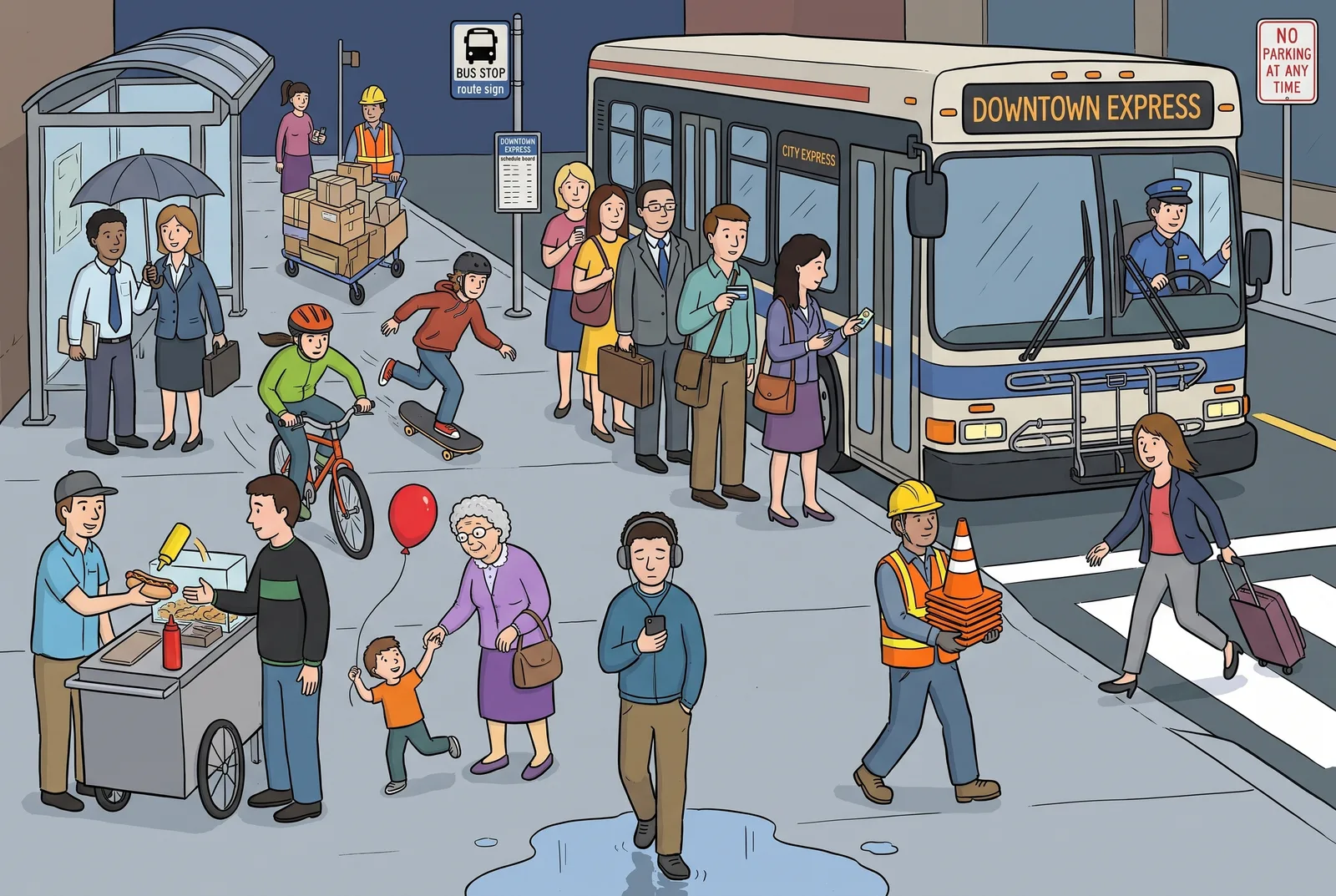
Task 3 / describe
Describe the scene to someone who cannot see it. Prepare for 30 seconds; speak for 60. Begin with the setting, then move through two or three areas of the picture.
Task 4 / predict
Explain what you think will happen next. Prepare for 30 seconds; speak for 60. Connect each prediction to something visible.
Observation -> supported prediction
A woman is at the front of the bus queue, holding a banknote. She will probably pay her fare and board the bus soon. A traveller is crossing in front of the bus with a suitcase. The driver may wait for her to finish crossing before pulling away.
Keep the two tasks distinct
In the description, avoid inventing people's jobs or destinations. In predictions, use language such as "may" or "probably" when the picture does not establish certainty. Multiple reasonable predictions are possible.
20Make the unusual easy to picture.
Task 8 / give your listener a clear mental image.
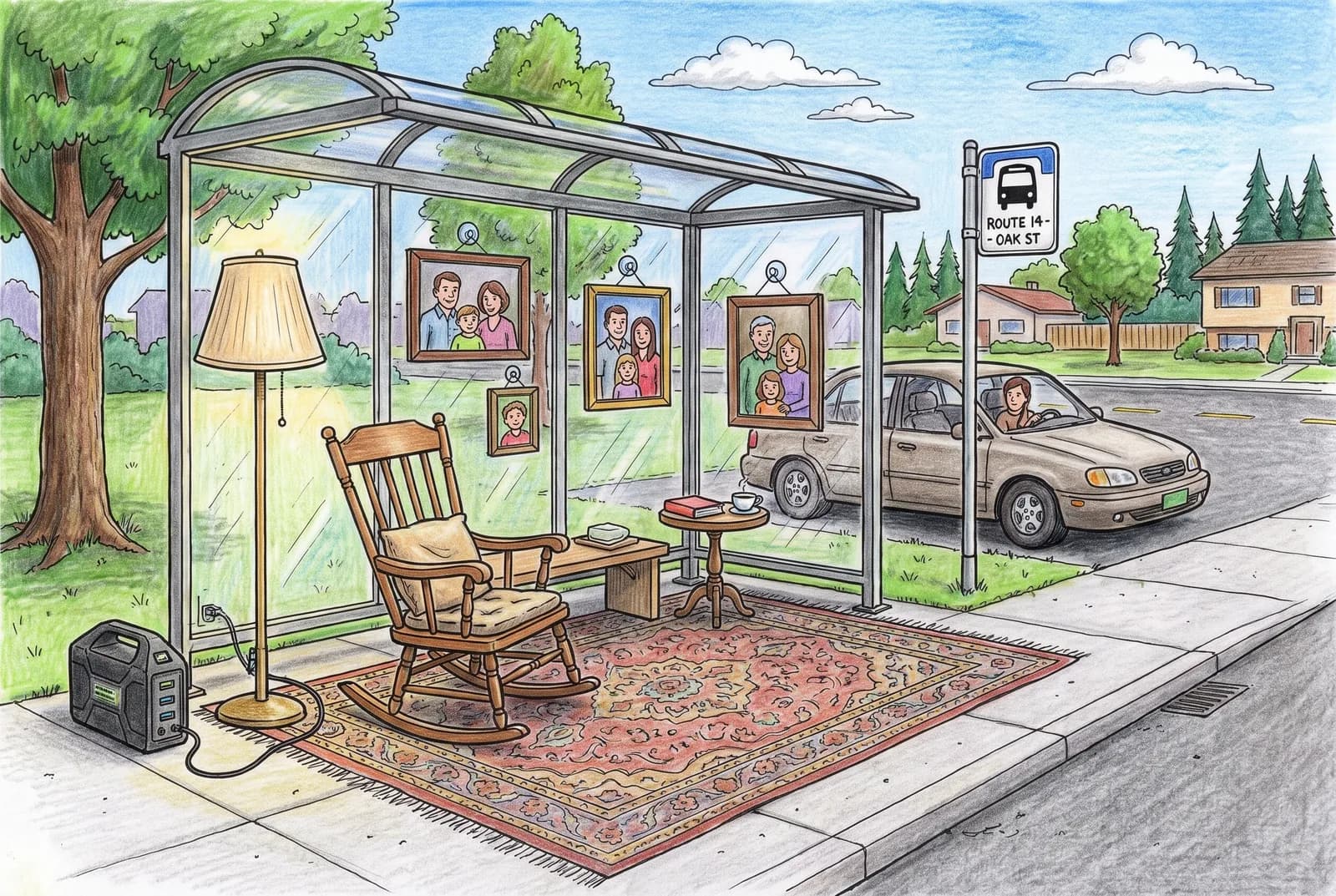
Your task
You are waiting for a bus and see this unusual shelter. Call your friend, describe it in detail, and explain why you think they would enjoy seeing it. Prepare for 30 seconds and speak for 60 seconds.
An example response
Hi Nina, you have to hear about the bus stop I'm at. Someone has furnished the glass shelter like a tiny living room. There's a wooden rocking chair on a patterned rug, with a tall lamp beside it. Several framed family photographs are hanging on the glass behind the chair. There's even a small round table with a cup on it. The strange part is that all this cosy furniture is right next to the road, under an ordinary curved bus shelter roof. It looks like someone moved their lounge outdoors. Since you love unexpected street art, I think you'd really enjoy taking a look on your next walk.
The comparison gives the listener a quick overall image. The positions and objects make it concrete. Your own response can select different details; it still needs to fulfil the whole request.
21Compare what actually matters.
Task 5 / a two-stage persuasion drill using text cards.
You and a colleague are choosing a venue for a 12-person team workshop. The budget is $300. Your team needs a quiet space with a screen.
| Stage 1 / choose A or B | A / Maple Room | B / Corner Cafe |
|---|---|---|
| Price | $280 for three hours | $220 for three hours |
| Capacity | 16 people | 12 people |
| Equipment | Screen and whiteboard | Screen, no whiteboard |
| Setting | Quiet private room | Quiet private cafe room |
Give yourself 60 seconds to choose. Keep the card below covered until you have chosen; there is no speaking in this stage.
Stage 2 / Harbour Studio
Your colleague suggests a quiet private room for 20 people with a screen and whiteboard. It costs $300 for three hours and is 25 minutes farther from the office than either original venue.
Now persuade
Reveal C. Prepare for another 60 seconds, then speak for 60 seconds. Persuade your colleague that your original choice is better than Harbour Studio. You may choose either original option, but your reasons must fit the facts.
Developed comparison / an excerpt
I'd still choose Maple Room. Both venues have a screen and enough seats, but Maple meets those needs for $20 less. It is also closer to the office, so the team would spend less time travelling for a workshop that only lasts three hours.
My choice / shared feature / meaningful difference / consequence
Space to complete in your downloaded workbook.
22Build a flexible language toolkit.
Useful language earns its place by doing a job.
| Job | A natural starting point | Add your own detail |
|---|---|---|
| Give advice | One thing I would check is... | Name the practical issue and why it matters. |
| Support a point | For example, if... | Describe a plausible situation, not an empty claim. |
| Compare | Both options..., but... | Compare the same feature on both sides. |
| Acknowledge a concern | I understand that..., so... | Recognize the other person's problem and respond to it. |
| Predict | Because..., they may... | Connect a visible clue to a possible outcome. |
| Describe position | Just behind... / on the left... | Anchor the next object to something already mentioned. |
| Clarify | What I mean is... | Restate briefly if your first wording is unclear. |
Avoid a sentence that fits every topic
"This is a very important issue in modern society" adds little to an answer about a broken pottery wheel or choosing a workshop room. Begin with the person, problem or decision in front of you.
Upgrade drill
Flat: "The room is better. It is good and convenient." Developed: "The room costs $280, so it leaves $20 of our $300 budget for other workshop costs."
A vague sentence from my own recording
Space to complete in your downloaded workbook.
My revision: specific detail + why it matters
Space to complete in your downloaded workbook.
Record both versions. Does the new detail make your meaning easier to follow?

Chapter 06 / Pages 23-26
Your study plan
Chapter 06 / Pages 23-26
Your study plan
23Four weeks, one repeatable habit.
A suggested routine for about 30-45 minutes on five days each week.
Adapt this to your starting level and test date. Some learners need longer. A full timed section or mock needs an additional longer session; the short routine below is not a promise of a particular score.
| Week | Focus | Five short sessions |
|---|---|---|
| 1 / Find your starting point | Learn the format; collect evidence. | 1: Explore an official sample. 2: Review a Listening attempt. 3: Review a Reading attempt. 4: Write one email. 5: Record two Speaking tasks and choose a priority. |
| 2 / Repair one weakness | Give the weakest skill four sessions. | 1: Study one error pattern. 2: Try a focused drill. 3: Revisit the drill and explain the change. 4: Practise another skill. 5: Test the priority on fresh material. |
| 3 / Extend the improvement | Add time pressure and a second skill. | 1: Timed practice. 2: Detailed review. 3: Writing or Speaking revision. 4: Fresh question in the next weakest skill. 5: Ask for feedback on one specific issue. |
| 4 / Rehearse & adjust | Check progress and prepare the routine. | 1: Compare a fresh attempt with week 1. 2: Repair recurring errors. 3: Rehearse the computer interface. 4: Light review and test-day checks. 5: Rest or a short confidence session. |
A 30-minute session
5 minutes: recall yesterday's lesson. 10 minutes: one focused attempt. 10 minutes: inspect the evidence. 5 minutes: retry a small part and log the next action.
If the test is next week
Learn the interface now. Prioritize the two clearest weaknesses, practise all four skills, and reserve one longer rehearsal. Do not compress four weeks of volume into every evening.
My five study slots this week
Space to complete in your downloaded workbook.
24The practice & repair log.
Fill this in digitally or print fresh copies when you need them.
Log what you changed, not just what you completed. One page can cover a week of short sessions.
| Date / skill | Task or resource | What the evidence showed | My next action |
|---|---|---|---|
| Example / Reading | Message drill, Q2 | I used opening time instead of arrival time. | Circle whose time the question asks for. |
Session 1 / date, skill, resource, evidence and next action
Space to complete in your downloaded workbook.
Session 2 / date, skill, resource, evidence and next action
Space to complete in your downloaded workbook.
Session 3 / date, skill, resource, evidence and next action
Space to complete in your downloaded workbook.
Session 4 / date, skill, resource, evidence and next action
Space to complete in your downloaded workbook.
Session 5 / date, skill, resource, evidence and next action
Space to complete in your downloaded workbook.
At the end of the week, try a fresh question. Can you show the same improvement without repeating a response you already know?
25Bring this page to your next lesson.
A reusable response review sheet for independent study or teacher feedback.
Date / skill / task / recording or document name
Space to complete in your downloaded workbook.
Who am I addressing, and what must my response achieve?
Space to complete in your downloaded workbook.
My plan: main point / supporting detail / next point / ending
Space to complete in your downloaded workbook.
| Review lens | What to check |
|---|---|
| Ideas | Main point is clear; relevant details explain it. |
| Language | Words fit the situation; grammar communicates the intended meaning. |
| Delivery / readability | The listener or reader can follow the response without reconstructing it. |
| The task | Every instruction is addressed; tone and length fit. |
Evidence from my first attempt: quote a sentence or note a timestamp
Space to complete in your downloaded workbook.
My revision: what I will change and why
Space to complete in your downloaded workbook.
Teacher or study partner: one strength / one priority / a useful exercise
Space to complete in your downloaded workbook.
After a fresh attempt: did the change help? What is next?
Space to complete in your downloaded workbook.
26Keep the right resources close.
A small reference shelf, and a calm finish to your preparation.
Use official sample tests to learn the interface and official rated responses to understand level differences. Use this companion for original skills practice, revision and planning.
- Official CELPIP Test Format & Scoring
Current component timing and unscored-item information.
- CELPIP Guidebook for Test Takers / July 2026
Component structure and scored question counts.
- Writing Pro: Target 9+ / official study pack
Task timing and Writing performance dimensions.
- Speaking Pro: Target 9+ / official study pack
Task timing and Speaking performance dimensions.
- Official CELPIP Score Comparison Chart
Rated samples and official commentary; use for calibration.
- Official CELPIP free online sample test
Practise the official interface, timing and audio flow.
- Official CELPIP Writing study strategies
Word-count flexibility and the risk of going far outside the range.
Your final 48 hours
Check the current test-day instructions in your booking confirmation: identification, arrival time and location. Plan your journey. Review familiar errors, test your comfortable speaking pace, and protect time for sleep.
For teachers and study partners
Share this free pack by linking to practicecelpip.ca/celpip-prep-pack so learners can find the current edition. Bring the response review sheet to a lesson and agree on one practical next step.
Created by CELPIP Practice / September 2026. Independent resource; not endorsed by the official CELPIP test provider. References checked 9 September 2026. Examples have no assigned CELPIP level.
Continue practising all four skillsBetter with a little guidance
Bring it to your next lesson.
Teachers can use the mini drills as lesson starters, work through the examples with a class, or use the review sheet to give a student one clear priority. Share the pack freely by linking to this page.
Built on the right foundations.
Format and timing checked against official CELPIP references on 9 September 2026. Original teaching examples and exercises by CELPIP Practice. Source links are included in the workbook.
Use it as a practice companion.
The mini drills focus on individual skills; they are not full mock tests or score predictions. The Listening drill includes a script for a partner to read. For the exam interface and recorded audio, use official sample tests alongside this pack.
Your next good practice session is waiting.
Free, printable, and ready when you are.